
Check the agreed scope first. If the request adds work beyond it, explain the change, the fee and the schedule effect, then ask for written approval before starting. If the boundary is unclear, ask a focused question before calling the request chargeable.
You do not need a tougher-sounding email. You need a reply that matches the situation. Below are three original templates for freelance web designers: an included correction, an additional request and an unclear brief. Each example is illustrative, not a real client result.
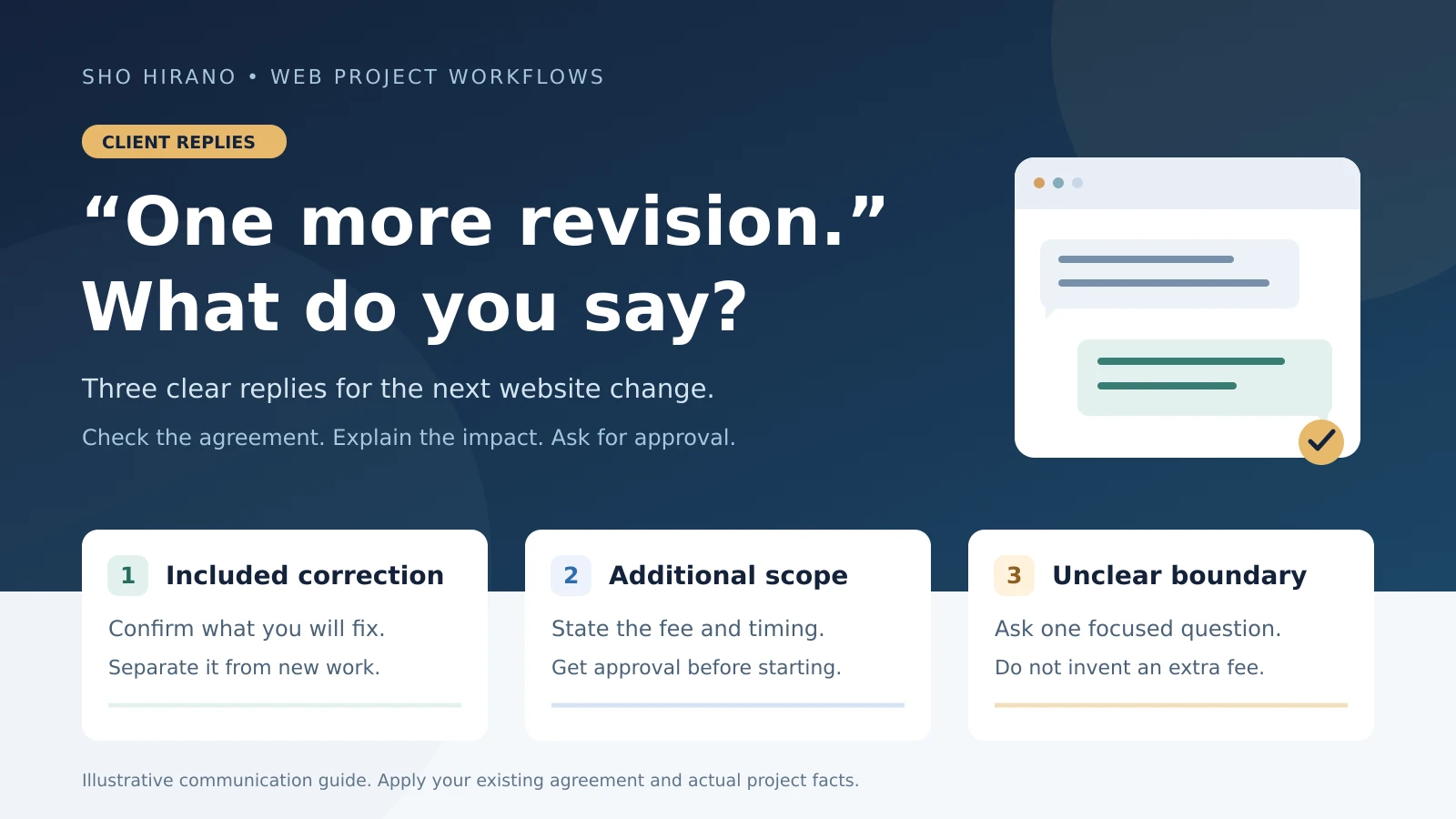
Which reply fits the request?
- Included correction: the delivered work misses an agreed requirement. Confirm the correction and its timing. Do not turn your own implementation error into new scope.
- Additional work: the request exceeds an agreed quantity, feature set or revision allowance. Identify the relevant boundary and propose the additional work before charging for it.
- Unclear boundary: the proposal or feedback leaves room for different interpretations. Clarify what was agreed and what the client wants before choosing a fee.
An included revision may still be available under your agreement. In that case, confirm what the current round covers rather than announcing an extra charge. A new feature is not automatically included just because the client requests it during a revision round.
1. When the request is an included correction
Illustrative situation: the approved design shows a contact button on mobile, but your build omitted it. The reply below assumes you have checked that it is your responsibility and can meet the stated date.
Subject: Mobile contact button on [project]
Hi [name],
I checked the approved layout. The mobile contact button should be there, so I will correct it within the agreed project fee. I will send the updated page by [confirmed date] and check the button on [agreed devices or browsers].
Your separate request for [new feature] needs a scope check. I will keep that separate from this correction so we can review its cost and timing before deciding.
[Your name]
Before sending: remove the second paragraph if there is no separate request. Replace the date only after checking your workload. If responsibility is uncertain, use the clarification reply instead of admitting an error you have not established.
2. When the client asks for work outside the agreed scope
Illustrative situation: a five-page website has been agreed. The client now requests a sixth landing page. The fee, currency and dates below are placeholders; they are not recommended market rates.
Subject: Decision needed: additional [page or feature]
Hi [name],
I have reviewed the request for [specific outcome]. Our current scope includes [relevant agreed deliverables]. This request adds [specific difference].
I can propose the following addition for your review:
• Included work: [design, build, review and testing included]
• Additional fee: [amount and currency, including the applicable tax treatment]
• Timing: [revised milestone or confirmed effect on the current date]
• Dependencies: [content, access or other input needed]
• Exclusions: [related work not included]If you prefer to keep the existing budget and scope, we can leave this addition out for now. Any exchange for an existing deliverable would need a separate check of the effort and schedule.
Please confirm which option you want. If you choose the addition, please approve the stated work, fee and timing in writing. I will not begin the additional work until we have that agreement.
[Your name]
Before sending: use the payment terms already agreed with the client. Do not invent a new upfront-payment requirement. If the timing is unknown, say you are preparing an estimate instead of filling in an optimistic date.
A worked fee example: show the assumptions
Suppose a fictional request needs 2 hours of design, 2 hours of implementation and 1 hour of testing and coordination. At an illustrative rate of US$75 per hour, the base estimate is 5 × US$75 = US$375. If your pricing approach includes a separately explained 20% contingency, the planning amount is US$450. The 20% is an example assumption, not a required surcharge or an industry standard.
Five hours of effort does not mean delivery tomorrow. Your schedule may depend on content, existing work and a review window. Explain the expected date separately. If tax or paid third-party services apply, show how they affect the actual quoted total. Use your own costs and agreed pricing method.
3. When “booking form” could mean two different things
Illustrative situation: the brief mentions a booking form. You interpreted that as a form that emails an enquiry. The client expects live calendar availability and payment. The wording is not clear enough to declare who is right.
Subject: Clarifying the booking flow for [project]
Hi [name],
Before I estimate this, I want to confirm the intended booking flow. By “booking form,” do you mean an enquiry sent to your team, or a customer selecting an available time and paying online?
My current plan covers [your documented understanding]. Please point me to any earlier notes or examples that describe a different flow so I can review them with you.
Once we confirm the expected result and the existing agreement, I can explain what is included and whether any additional work, fee or schedule change needs approval.
[Your name]
Before sending: replace your interpretation with the actual documented understanding. Do not present it as a mutually agreed exclusion unless the records support that.
What if the client says the budget cannot increase?
Offer a decision you can actually support: keep the current deliverable, consider the addition in a later phase, or evaluate a specific scope swap. A swap still needs an effort and dependency check. Do not promise the same budget, more features and the same deadline simply to end an uncomfortable conversation.
You can write: “I understand the budget needs to stay at [amount]. I will keep the current scope unchanged. If [new feature] is the priority, I can assess whether replacing [existing deliverable] would fit, then send the scope and timing for your approval.” Use this only when you are willing to assess that option.
A final check before sending
- The message points to a real agreement or clearly identifies an uncertainty.
- An included correction is separate from additional work.
- The proposed deliverable, price and currency are specific.
- The timing reflects dependencies, not just estimated hours.
- The client can see what happens if they decline the addition.
- All placeholders are replaced and any written approval is saved with the project record.
These templates support a project conversation. They do not amend an agreement by themselves, replace legal advice or guarantee that a client will approve a fee. Adapt them to your existing terms and circumstances.
Start with a free scope check
If you are not yet sure which reply applies, use the five-step Scope-Change Triage. The checklist and a short reply are available on the page without registration. An optional email signup appears separately.
For editable worksheets, the Client Reply Pack and formula-based estimating, the Web Project Change Kit v1.1 contains 13 files: 3 PDFs, 6 DOCX documents, 2 XLSX workbooks and 2 TXT files. The listed price is US$29, one time, under a single-user business-use license. Review the product page and checkout for the full terms and final total.
Disclosure: Web Project Change Kit is my own product. The examples in this article are original fictional teaching examples, not testimonials or claims of customer savings.
Related practical guides
- Write a website change request before you quote
- Estimate the price and schedule impact of an out-of-scope request
Why this problem deserves a clear process
In its 2026 industry report, Squarespace lists scope creep among the top challenges for 37% of surveyed web designers. The report describes a survey of 1,034 designers conducted in November 2025. This is context about the problem, not proof that any template or product increases income. Read the survey and its method. Source checked November 8, 2026.